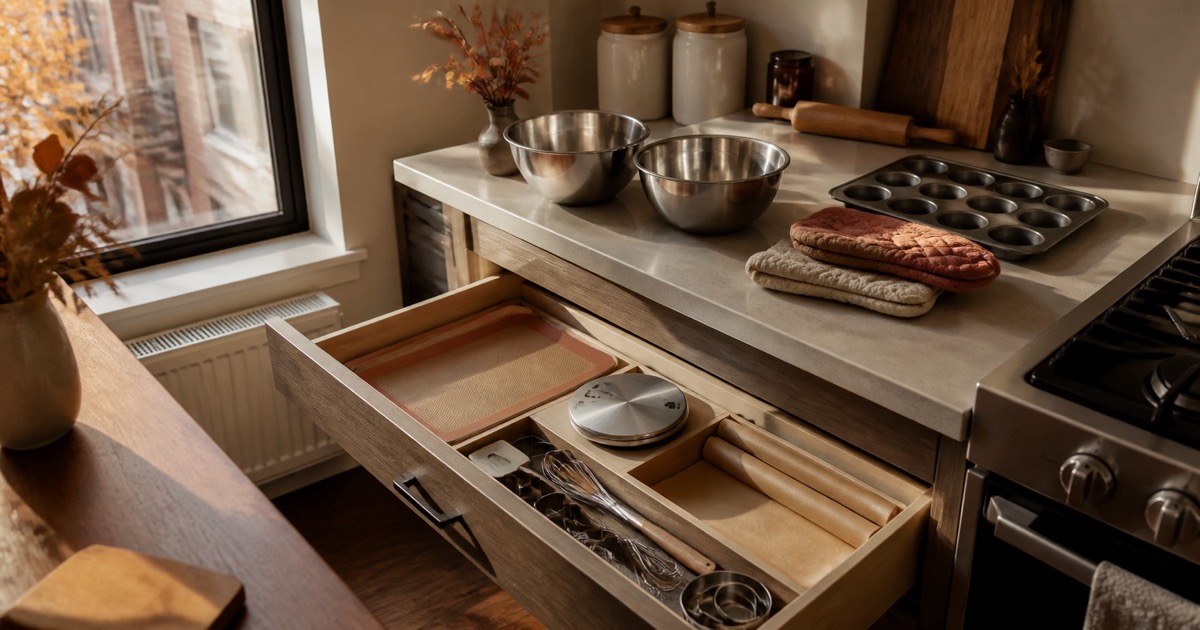
Early fall makes weekend baking feel appealing before a small kitchen is ready for it. A recipe can sound simple, then the counter fills with bowls, pans, liners, mitts, measuring tools, and the items that were already living in the drawer. The issue is rarely one tool. It is the way tools compete for reach, cleanup, and storage.
A useful baking drawer is not a miniature pastry kitchen. It is a compact edit of pieces that repeat across muffins, quick breads, cookies, simple cakes, granola, roasted fruit, and casual Sunday projects. The best choices are easy to find, easy to clean, and easy to return before the weekday kitchen routine begins again.
This guide avoids recipe outcome, heat-protection, material-safety, and appliance-compatibility promises. Use retailer and manufacturer pages to confirm dimensions, care instructions, temperature guidance, material details, and return terms. The aim is to compare storage fit and practical role before adding another tool.
Quick Answer
Build the drawer around five jobs: one set of nesting mixing bowls, one flexible baking mat if it fits the pans already owned, one muffin pan only if small bakes happen repeatedly, one food scale for recipes that benefit from measured ingredients, and one pair of oven mitts that has a clear place near the oven.
The compact version works because every piece has a job beyond a single recipe. Bowls mix and hold, a mat can support several sheet-pan routines when compatible, a muffin pan makes portioned baking easier, a scale reduces measuring clutter for some cooks, and mitts keep the oven zone organized. If a tool does not repeat, it should wait.
Shop the Edit
Elite Fashion may earn a commission from qualifying purchases made through shopping links on this page. Links are chosen for editorial fit and practical relevance to the article topic.
Start With the Drawer, Not the Recipe
Small kitchens punish optimistic buying. Before choosing a pan or bowl set, measure the drawer depth, shelf height, and the counter area available when the project starts. A beautiful tool that cannot be stored cleanly may become the reason baking feels like work before the ingredients come out.
Pull everything out of the baking area and group it by job: mixing, lining, baking, measuring, and oven handling. Duplicates become obvious quickly. The goal is not to own every format; it is to create a drawer that tells the cook where each step begins.
Choose Bowls That Nest and Actually Get Used
Mixing bowls are the foundation because they appear in nearly every weekend bake. Stainless steel bowls are often considered for durability and lower weight, but the decision should stay practical: diameter, depth, rim grip, bottom stability, nesting height, and whether the largest bowl fits the cabinet.
A bowl set should also serve non-baking moments. If it can hold washed berries, tossed salad, pancake batter, or chopped vegetables, it earns space more easily than a specialty item. In a small kitchen, repeated everyday use is the strongest argument for keeping a tool near the front.
Treat the Baking Mat as a Fit Question
A silicone baking mat can reduce disposable liner use for some routines, but it only helps when it fits the pan and the cook is willing to clean and store it properly. Compare dimensions against the baking sheets already owned rather than assuming a standard size will work.
Storage matters as much as use. A mat that has to be folded, crammed, or hidden behind pans may not survive the month. If it rolls neatly, dries fully, and returns to the same drawer space, it is more likely to become part of weekend habit.
Give the Muffin Pan a Real Reason
A muffin pan is useful when portioned baking is part of the household rhythm: muffins, egg cups, small cakes, lunchbox portions, or casual brunch. If those recipes happen twice a year, the pan may be borrowing space from tools that work every week.
Compare cavity count, pan width, edge grip, and how the pan stores vertically or horizontally. In a narrow kitchen, a smaller pan that stores cleanly may beat a larger one that always blocks the drawer. The right pan is the one that comes out without moving five other things first.
Decide Whether a Food Scale Replaces Clutter
A compact food scale is not necessary for every cook, but it can make some baking routines calmer by reducing cup and spoon clutter or helping recipes that use weight measurements. Compare display angle, unit switching, platform size, battery access, and how easily it wipes down.
The scale should have a home. If it lives loose beside whisks and cutters, it can become one more fragile item to avoid. A shallow tray, drawer divider, or upper shelf can make it easier to reach without burying the display or buttons.
Keep Oven Mitts Near the Moment of Use
Oven mitts often fail because they are stored wherever space remains. For baking, they need to live near the oven, not under the bowls or behind the pan. Compare length, hanging loop, cleaning guidance, and whether the pair fits the user's hand well enough to move confidently around the oven zone.
Do not treat a product page as a universal protection claim. Heat exposure, handling style, moisture, and manufacturer instructions all matter. The buying decision here is about storage, reach, care, and whether the mitts help the kitchen reset after the tray comes out.
Make the Weekend Reset Part of the Plan
A baking drawer is only successful after the bake is over. Bowls need to dry before nesting, mats need to be cleaned and stored flat or rolled according to guidance, pans need a return direction, and the scale should not be left on the counter because the drawer is full.
Set the drawer so the most repeated pieces return first. Bowls in the back may be fine if they nest; mitts near the oven may need a hook; the scale may need a sleeve or tray. The small kitchen stays calmer when cleanup is designed into the purchase, not treated as a separate chore.
Comparison Points
| Piece | What to compare |
|---|---|
| Mixing bowls | Compare nesting height, diameter, depth, rim behavior, weight, and whether the bowls work beyond baking. |
| Silicone baking mat | Compare pan fit, cleaning routine, drying space, storage shape, and manufacturer care guidance. |
| Muffin pan | Compare cavity count, pan footprint, edge grip, and whether portioned baking happens often enough. |
| Food scale | Compare display readability, unit controls, platform size, battery access, and drawer protection. |
| Oven mitts | Compare length, hanging loop, cleaning guidance, hand fit, and proximity to the oven. |
Use Cases
Apartment weekend baking
Choose nesting bowls, a compatible liner, and one pan that can be reached without emptying the drawer.
Casual brunch prep
A muffin pan and scale help only when the recipe routine repeats enough to justify the storage.
Shared kitchen
Keep mitts visible, bowls nested, and the mat stored predictably so cleanup does not depend on one careful person.
Before You Buy
Use retailer pages to confirm sizing, dimensions, materials, care instructions, color options, delivery timing, and return terms. The best choice is the one that fits the real routine and the real storage space, not the one that looks most complete in isolation.
After the first week of use, notice what was reached for, what stayed in the drawer, and what made cleanup harder. That small review is often more useful than adding another product before the routine has proved itself.
Browse Category Hubs
Use these broader category hubs after the article-specific product options. Narrow by size, material, format, care needs, delivery options, and the space available at home or work.
FAQ
What belongs in a small-kitchen baking drawer?
Start with nesting bowls, a liner that fits existing pans, one useful pan, a compact measuring tool if needed, and mitts stored near the oven.
Is a silicone baking mat worth it in a small kitchen?
It can be useful when it fits the pans you own, cleans up easily, and has a clear storage place.
Should I buy a food scale for casual baking?
Buy one when your repeated recipes use weight measurements or when it reduces measuring clutter in a small prep space.