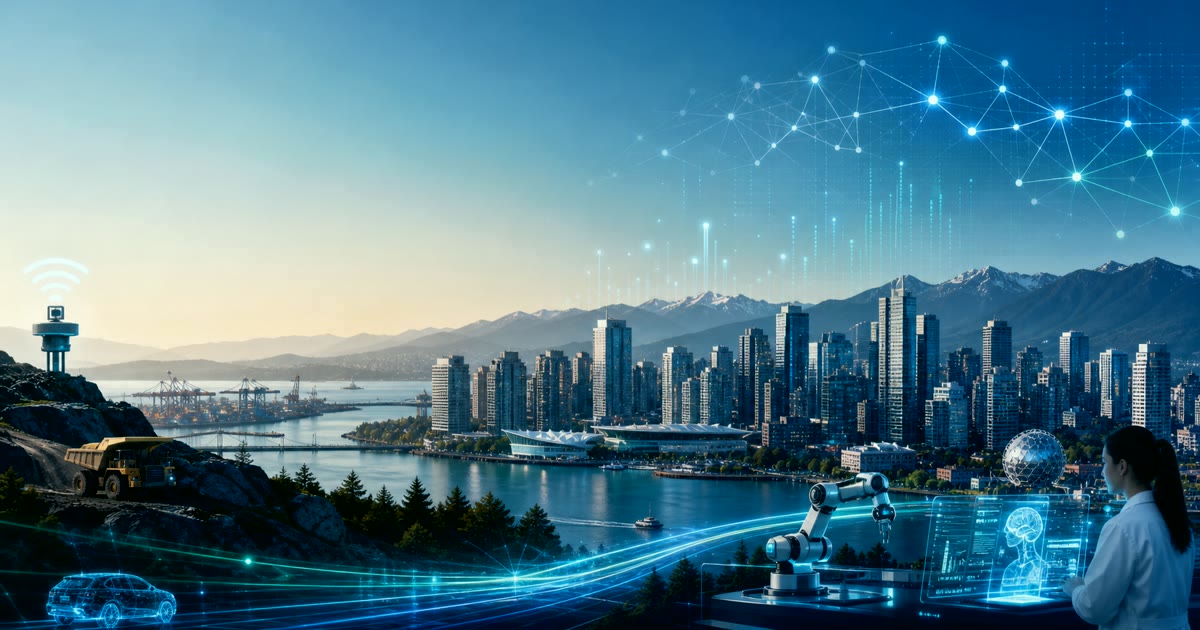
Metro Vancouver's AI story is not only about model labs or headline-making consumer apps. The strongest signal in Invest Vancouver's 2024 sector profile is that the region is becoming an applied AI market: companies are using machine learning, computer vision, robotics, and data systems to solve specific problems in health, mining, agritech, cleantech, finance, logistics, and city infrastructure.
The report, titled Industry Overview: Artificial Intelligence (AI), says the region had more than 180 companies developing, integrating, or building AI and machine-learning products and services as of November 2024. It also reports more than $1.8 billion USD in investment into Metro Vancouver-headquartered AI companies from 2018 through 2023, using PitchBook as the investment source. 1
This matters for readers beyond the local tech sector. Fashion retail, beauty, wellness, outdoor mobility, healthcare, creative tooling, and ecommerce all depend on the same AI infrastructure: data talent, computer vision, human-centered design, logistics, and commercially tested software. Metro Vancouver's advantage is not that it owns every layer of the global AI stack. Its advantage is that it has enough research, capital, industry use cases, and regional problem sets to make AI visibly useful.
Source basis for this report
- Invest Vancouver, Industry Overview: Artificial Intelligence (AI), 2024 PDF. The PDF used for this article was also provided as the attached file
AI_MV_SectorProfile2024.pdf. - Invest Vancouver Artificial Intelligence industry page, used to cross-check the public sector overview and current online presentation.
Why This Profile Is More Than a Regional Fact Sheet
A two-page sector profile can look like marketing collateral at first glance. This one is more useful than that because its data points line up around one thesis: Metro Vancouver is not trying to win AI with a single central institute or one dominant employer. It is building an ecosystem across multiple verticals, with company clusters, university capacity, public-sector supports, and real deployment pilots reinforcing one another.
Applied AI is the through-line
The report's company examples are not confined to generic software. They span life sciences, agritech, robotics, mining technology, SaaS, and cleantech. That breadth is important. AI ecosystems become durable when they are connected to real industry demand, not just research demos. A health AI company and a mining computer-vision company may use different datasets, but both need machine-learning engineers, product designers, data infrastructure, and buyers with operational problems.
For Metro Vancouver, that makes the AI cluster more resilient. If one vertical cools, another can still pull talent and capital forward. A fashion or lifestyle reader can read the same signal differently: the region's AI capacity is relevant to virtual try-on, demand forecasting, personalized shopping, retail analytics, sustainable materials, health monitoring, and logistics optimization.
The investment pattern needs context
The headline number is the $1.8 billion-plus investment total from 2018 to 2023. The annual pattern is uneven: $73 million in 2018, $143 million in 2019, a major spike to $962 million in 2020, then $419 million in 2021, $167 million in 2022, and $54 million in 2023. Invest Vancouver attributes that chart to PitchBook, 2024. 1
The unevenness should not be read as a simple decline story. AI investment globally shifted after the 2020-2021 technology cycle, while the funding environment tightened across many startup categories in 2022 and 2023. What matters in this profile is that capital had already found multiple Metro Vancouver AI companies before the generative AI boom reached mainstream attention.
The most interesting AI regions are not the loudest ones. They are the places where machine intelligence is already embedded in health, movement, energy, materials, infrastructure, and everyday operations.
The Six-Sector Map: Where Metro Vancouver AI Shows Up
The profile names six areas of specialization. That map is useful because it prevents the AI conversation from collapsing into chatbots alone. Metro Vancouver's ecosystem is presented as life sciences, agritech, robotics, minetech, SaaS, and cleantech, with companies named in each category. 1
Health, life sciences, and human data
The profile lists Clarius AI, Molecular You, and Variational AI under life sciences. The common thread is not simply "AI in healthcare." It is the move toward imaging, molecular insight, drug discovery, diagnostics, and data interpretation. Those are high-trust markets where model quality, validation, privacy, and clinician workflows matter as much as the algorithm itself.
This is where Metro Vancouver's university and hospital-adjacent talent base matters. If AI is going to support healthcare rather than merely automate paperwork, it needs domain experts close enough to product teams to shape what gets built. That is one reason the region's UBC and SFU research base is central to the report's argument.
Agritech, mining, and cleantech as industrial AI
Agritech names include Terramera, Semios, and Ecoation. Minetech includes Weir Motion Metrics and Ideon Technologies. Cleantech includes Intuitive AI and Clir Renewables. These categories are especially important in British Columbia because they connect AI to land, resources, climate, and operational efficiency.
In practical terms, this means computer vision, sensing, prediction, and decision support are being aimed at crop health, mine safety, resource discovery, renewable-energy performance, and waste or consumption reduction. For a region that sits between port logistics, resource industries, and urban sustainability goals, industrial AI may be more economically meaningful than consumer novelty.
Robotics and SaaS connect the cluster to daily operations
The robotics examples in the profile include Sanctuary AI, Apera AI, and A&K Robotics. The SaaS examples include CoPilot AI, Gumloop, and Browse AI. These companies represent the two ends of applied automation: embodied systems that move through physical environments, and software platforms that help businesses automate sales, browsing, data extraction, workflow, and customer operations.
That pairing is important for lifestyle industries. Fashion, beauty, wellness, and retail are not only media categories; they are supply chains, appointments, inventory, customer journeys, returns, fulfilment, and digital discovery. SaaS and robotics are the layers that can turn AI from a novelty into a more efficient operating model.
| Sector in the profile | Examples named by Invest Vancouver | Why it matters |
|---|---|---|
| Life sciences | Clarius AI, Molecular You, Variational AI | AI moves into imaging, molecular insight, diagnostics, and discovery. |
| Agritech | Terramera, Semios, Ecoation | Prediction and sensing support food systems and climate adaptation. |
| Robotics | Sanctuary AI, Apera AI, A&K Robotics | Automation leaves the screen and enters physical environments. |
| Minetech | Weir Motion Metrics, Ideon Technologies | Computer vision and sensing support safer, cleaner resource work. |
| SaaS | CoPilot AI, Gumloop, Browse AI | AI becomes a workflow layer for businesses and creators. |
| Cleantech | Intuitive AI, Clir Renewables | Data systems help reduce waste and improve energy performance. |
Multinational Signals: Why Outside Firms Keep Showing Up
A local startup map is one half of an AI ecosystem. The other half is whether outside companies see the region as a place to build, acquire, or expand. Invest Vancouver's timeline lists several multinational and cross-border moves from 2019 through 2024, including Fujitsu, Mastercard, Weir Group, Glia, Silo AI, and Wayve. 1
From headquarters to acquisitions
The profile says Fujitsu selected Vancouver for its global AI headquarters in 2019. In 2020, Mastercard invested $510 million to establish a global technology innovation centre in Vancouver with work tied to transaction security, cybersecurity, AI, and connected technology. In 2021, Weir Group acquired Vancouver-based Motion Metrics to integrate machine vision into mining.
Those moves tell different stories. Fujitsu signals headquarters confidence. Mastercard signals corporate innovation infrastructure. Weir's acquisition shows that Vancouver AI can become strategically valuable to global industrial companies. Together, they suggest that the region is not merely attracting branch offices; it is also producing assets that larger firms want to integrate.
Autonomous systems and global AI labs
The profile also notes Glia's acquisition of Vancouver-based Finn AI in 2022, Silo AI opening a Vancouver office in 2023, and Wayve opening an AI hub in Vancouver in 2024. The Wayve signal is especially relevant because autonomous-vehicle software requires a deep mix of machine learning, simulation, perception, safety, data systems, and engineering talent.
In the broader AI market, cities compete not only for founders but for specialized teams. A new AI hub can pull talent into a region, but it can also validate the region's existing talent base. When large firms choose Vancouver for AI work, they are implicitly betting that the local labor market, universities, infrastructure, and quality of life can support serious technical output.
The lifestyle connection: why this matters outside enterprise tech
Multinational AI activity eventually shapes consumer life. Transaction security affects online shopping. Chatbot and virtual banking capabilities affect financial access. Autonomous systems affect mobility. Industrial computer vision affects resource safety and materials supply chains. These are not abstract back-end developments; they help determine what kinds of products, services, and city experiences become possible.
For Elite Fashion's Vibe AI coverage, this is the reason to treat regional AI profiles seriously. The next wave of consumer AI will not only come from consumer apps. It will come from applied systems that make cities, supply chains, healthcare, retail, and logistics more responsive.
Research and Public Support: The Infrastructure Beneath the Headline
The second page of the profile turns from companies to infrastructure. It highlights research universities, incentives, and programs that support AI development. This is where Metro Vancouver's story becomes more than a list of companies: it becomes a talent and commercialization pipeline.
SFU, UBC, and the research base
Invest Vancouver identifies Simon Fraser University as highly ranked for AI capabilities and known for its Big Data Hub. It also highlights UBC's Centre for Artificial Intelligence Decision-making and Action, noting a network of more than 100 professors and research associates across 27 departments, schools, and institutes. 1
The cross-department detail matters. AI that works in the real world rarely stays inside computer science. It needs health expertise, materials science, policy, ethics, transportation knowledge, business design, and social understanding. A university network that crosses departments can help convert AI from technical capability into domain-specific product judgment.
Funding and commercialization supports
The incentives section names the Regional Artificial Intelligence Initiative, PacifiCan Business Scale-up and Productivity Program, Industrial Research Assistance Program, Innovate BC Ignite Program, and Creative Destruction Lab Vancouver's Compute Stream. The profile lists support ranges such as $500,000 to $3 million in repayable AI contributions for businesses, $500,000 to $5 million in non-repayable contributions for non-profits, up to $5 million through PacifiCan's BSP program, and $300,000 through Innovate BC Ignite. 1
Funding alone does not create an ecosystem. But targeted funding can reduce the gap between prototype and market. That gap is especially hard in AI because teams need data, compute, testing, privacy review, customer integration, and technical talent before revenue arrives. Regional support programs can make the difference between a promising research result and a deployable product.
Why founders should read the supports as a roadmap
For founders, the support list is not just a benefits page. It reveals the region's priorities: commercialization, productivity, applied R&D, advanced computing, and industry problem-solving. If a startup can show a real customer problem in natural resources, engineering, applied science, health, accessibility, or business productivity, it may fit the ecosystem better than a generic AI wrapper.
That is useful editorially because it helps distinguish substantive AI companies from trend-chasing. A strong Metro Vancouver AI company should be able to answer three questions: What domain problem does it solve? What data or technical moat supports it? What regional institution, customer, or partner can help it scale responsibly?
Deployment Examples: Where the Ecosystem Becomes Visible
The profile closes with ongoing developments that show AI moving into practice. The examples cover healthcare, airport accessibility, manufacturing, and commercialization funding. That deployment layer is the most important part of the story because it shows how an AI ecosystem touches everyday systems.
Healthcare and commercialization
Invest Vancouver notes that DIGITAL announced funding for a project involving WELL Health Technologies and SFU to apply AI-powered technologies in healthcare. It also says DIGITAL invested $53 million in firms commercializing AI, including local companies Ideon Technologies and Satisfai Health. 1
The healthcare example is significant because medical AI has a high bar. It must earn trust from clinicians, patients, regulators, and institutions. If the region can support healthcare AI commercialization, it strengthens the argument that Metro Vancouver is not only producing software experiments but building technology in high-accountability environments.
Airport accessibility and robotics
The profile also highlights Vancouver International Airport's partnership with A&K Robotics to test autonomous robotic pods intended to improve accessibility for travelers. The pilot is connected to an Innovate BC initiative that helps local companies develop, scale, and export solutions through industry and community partnerships. 1
This example matters because it puts robotics inside a public-facing environment. Airports are complex spaces: wayfinding, safety, accessibility, crowds, infrastructure, and service expectations all intersect. A successful airport robotics pilot can teach a region how to test AI in the real world without treating people as an afterthought.
Manufacturing and embodied AI
Sanctuary AI's partnership with Magna International is another sign of applied ambition. The profile describes Magna as a major automotive parts manufacturer and says the partnership is aimed at deploying AI robots in manufacturing facilities. 1
The manufacturing example is a reminder that AI is becoming physical. The important questions are no longer only about chat inputs and interfaces. They are about safety, reliability, human-machine collaboration, maintenance, training, and return on investment. Metro Vancouver's AI story becomes more serious when it includes that kind of embodied deployment.
What the report does not claim
The profile does not say Metro Vancouver is the largest AI market in North America, nor does it prove every company named is currently scaling at the same rate. Its stronger claim is narrower and more credible: the region has a broad applied AI base, meaningful investment history, research capacity, support programs, and visible deployment partnerships.
What This Means for Fashion, Lifestyle, and Consumer AI
At first, a regional AI sector profile may seem far from fashion and lifestyle. It is not. Fashion, beauty, wellness, travel, outdoor recreation, and city life increasingly rely on the same technical foundations named in the report: computer vision, recommendation systems, robotics, health data, logistics optimization, sustainability analytics, and AI-assisted customer experience.
Retail and creative tools
SaaS companies such as CoPilot AI, Gumloop, and Browse AI point toward automation in sales, workflows, and data collection. Those capabilities matter for independent brands and creators. A fashion founder may not build a model from scratch, but they can use AI workflows to research trends, qualify leads, automate content production, and monitor customer signals.
This connects to our broader Vibe AI coverage on AI trend forecasting, AI productivity for remote fashion professionals, and virtual try-on technology. Regional AI infrastructure does not stay locked in enterprise reports; it filters into the everyday stack used by small teams and digital-first creators.
Health, movement, and accessibility
The healthcare and airport robotics examples also connect to wellness and movement. AI that improves diagnostics, accessibility, health workflows, or mobility services can affect how people move through cities and manage personal health. For lifestyle media, that is where AI becomes more than productivity software: it becomes part of public experience and personal independence.
Vancouver's combination of health research, robotics pilots, outdoor geography, and urban density gives the region a useful test environment. A technology that works for airports, clinics, logistics, mountains, port infrastructure, and dense neighborhoods is likely to be more robust than one designed only for an app demo.
The regional advantage is coherence
The key takeaway from the 2024 profile is coherence. Metro Vancouver's AI ecosystem is not only a scatter of companies. It has sector breadth, university depth, multinational validation, and public support programs. The region's challenge is to convert that coherence into more globally visible companies, stronger commercialization, and responsible deployment.
For readers watching AI from a fashion, beauty, wellness, or culture perspective, this is the useful lens: pay attention to places where AI is being tested against real constraints. Metro Vancouver's AI story is not about hype alone. It is about whether a region can turn technical talent into tools that help industries and people move better.
Bottom Line
Invest Vancouver's 2024 AI sector profile presents Metro Vancouver as a credible applied AI hub: more than 180 companies, more than $1.8 billion USD in 2018-2023 investment, six named sector clusters, major multinational signals, university research depth, public support programs, and deployment examples in healthcare, robotics, airport accessibility, and manufacturing.
The strongest reading
The strongest reading is not that Vancouver has already won the AI race. It is that the region has the ingredients of an AI market that can matter: applied industries, research talent, investor history, corporate attention, and use cases that connect to real economic and civic needs.
The open question
The open question is whether Metro Vancouver can keep turning that foundation into companies with global visibility. That will depend on talent retention, customer access, patient capital, compute access, procurement pathways, and the ability to commercialize AI responsibly in high-trust domains.
Why we covered it in Vibe AI
We placed this report in Vibe AI because the category tracks how AI reshapes work, shopping, health, movement, creativity, and lifestyle. A regional AI sector profile is part of that story. It shows where the systems behind future consumer experiences are being built.